
mauipressurewashing

Guide to Solar Panel Cleaning
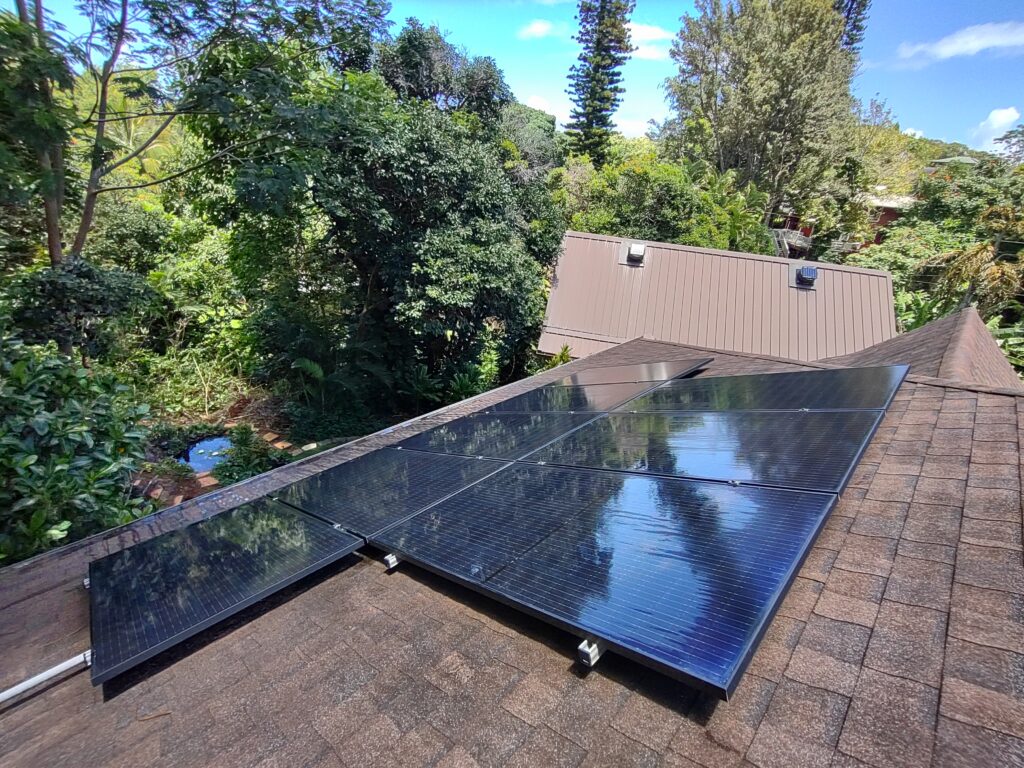
We clean solar panels all throughout the Hawaiian Islands, mostly Maui. We’ve had a bunch of people ask how to clean solar panels on their own, including family, so we decided to share a quick write-up on how we have advised people in the past. The commercial process is a little different than the process of cleaning them on your own.
When we clean panels, we utilize a wide variety of brushes, typically brushes that would be acceptable for washing cars and trucks. We utilize water purification systems that require a series of filters to maximize the efficiency.
***If you clean panels on your own, you take the risk on your own. Cleaning solar panels has major risks, especially including ELECTROCUTION and FALL HAZARDS, which can result in injury and/or death. If you injure yourself, damage your panels, or have any other issue resulting from the use of this solar panel cleaning guide, all liability falls on the user.***
Brushes
As a solar panel grid owner/lessee, there are car wash brushes and painters poles at any major home/auto supply (mostly all electrically conductive), and there are usually car wash brushes, often referred to as soft brushes. A typical solar panel cleaning requires a brush to be placed on a 12-20 ft. pole, which can be found in the painting section. If you can find a brush that will feed water up to the brush (the pole plugs into a hose), that is the optimal water delivery system. If you can’t find a brush that feeds water to the brush through it, you will need a hose nozzle as well.
Filters
The water coming out of the hose at your house usually has too high of TDS (Total Dissolved Solids), but you can check this with a TDS meter, available from most plumbing suppliers. Typically, you don’t want to use any water with a TDS reading over 020. Optimal use is a TDS reading of between 000-002. If you find you have something over that, you’ll need a filter. You don’t want to put hard water up on the solar panels, as most of the time this will lead to water spotting and, in general, they still look like someone hosed down a dirty sheet instead of fully washing it. The lower the TDS the better. There are some retailers that sell in line filters, usually the most optimal one to buy would be a small deionization filter, or a reverse osmosis filter. Either way, you’ll need a tester to see if it brings your water’s TDS reading down low enough. These filters would typically be referred to as “car wash filters”.
Hoses
Most garden hoses will work for this application, you’ll need one going into the filter, and another one coming out to hook up to your brush, or to be used for spraying down the panels while you scrub. If you have to do the latter and spray it down, you’ll want someone with you the whole time rinsing constantly. If your pole feeds water, just leave it maxed out. The more water the better. The filter will restrict the waterflow anyway, so as much as you can get.
Soaps
In terms of soaps, we typically stay away from these. When soap gets on to solar panels and flash dries, as they are often hot, it leaves semi-permanent spots on the panels that will inhibit production. We also try to stay away from soaps altogether because we don’t want chemicals interacting with the pile of electronics on and around the panels. Corrosion is the main problem you’re looking at when using soap.
Cleaning
Once we’ve got all that established, it’s time to clean the panels. One of the best ways to proceed, since the frames are usually the dirtiest part, is to clean around the edges and the frames first. Anything that dries on the panel is harder to get off as you work, so you need to keep it all wet until the entire panel is cleaned. You’ll want to go panel by panel, scrubbing the frame first, then cleaning the middle, then rinsing down the whole thing the best as you can. This is hard work, but finding the right angle to approach the cleaning from and using the right tools is half the work. You’ll want to go from the highest point on the grid, working across and down, just like reading a book. If you start at the bottom and work up, what you just cleaned becomes covered in dirt as you move up the rows. It doesn’t hurt to give the whole project a rinse down when you’re done, you’ve always got to be aware of where the dirty water is landing. If you’re getting all your furniture dirty, you’ll want to rinse it off.
Now, if you’re scrubbing and scrubbing and it’s just not coming clean, you may have some other issues up there. The first issue you’ll run into is heavy algae growth. That is when the panel is blackened, and the soft brush won’t get it. For this issue we typically use stronger brushes made specifically for solar panels. The second issue you’ll run into is caked on dirt. Typically when a sprinkler with heavy water repeatedly sprays the panels. To remove this is a chemical process, which runs the risk of cooking the electronics.
Again, if you take on solar panel cleaning on your own, there are risks. You can hit a powerline with a pole. You can fall off a roof or ladder. You can do any number of things that could lead to permanent injury or paralysis while up there. All of that being said, if you want to take on the risk, the above is how I have advised my family to do so. Just don’t come crying to me if you mess up your panels or your spine in the process. Good luck cleaning those solar panels.

Editor's Pick
Leave A Comment
Related Posts
Guide to Solar Panel Cleaning We clean solar panels all throughout the Hawaiian Islands, mostly Maui. We've had a bunch of people ask how to clean solar panels on their own, including family, so we decided to share a quick write-up on how we have advised people in the past. The commercial process is [...]

Maui Pressure Washing LLC has been cleaning on the Island of Maui for 10+ years. This company officially started in 2014, but we have always had a knack for taking care of Maui properties. When we started this company, there was a clear need for people who are passionate about preserving property on [...]

People often ask us, "Do solar panels need to be cleaned?" There are a few ways to answer this, but the primary comparison to be done is how much does it cost to clean vs. how much energy production is returned to the system when they are cleaned? There are some systems that won't [...]
